
How do you propagate plants?

Taking cuttings and starting new plants is considered very easy and is an inexpensive beginner-level method for growing new plants from existing ones. Many plants, such as houseplants, perennials, shrubs and even trees, can easily be propagated in water or potting mix in just a few weeks.
Whether you want to grow your collection or give them as a gift to make someone happy, we explain here how to easily multiply your houseplants.
The advantage of propagation with cuttings vs. seeds
With cuttings, you’re using leaves, stems or roots of a mature plant. This practice is different from growing plants from seeds. The cuttings will grow to be exact copies of the mother plant. With seeds, not all plants grow true to type, meaning the offspring might not look like the parent. Seeds need pollination, which results from the mix of genetic material from two parent plants. Your cutting, on the other hand, will be an exact copy of the plant it came from.
Is it better to put cuttings in water or soil?
You should know that for most plants, it is best to take cuttings during their growing season, so in spring and summer. To start roots from a cutting, you have two options: start them either in plain water or in a potting mix. Some soft-stemmed houseplants can do just fine in water, while woodier plants require a potting mix and higher humidity. While cuttings from some plants root easily, others are more difficult to root.
Rooting hormones can be used to increase the success of cuttings, to shorten the period needed for rooting, and to increase the number of roots per cutting. Professional growers use PRO-MIX ROOTS Liquid Root Stimulator because it has a high percentage of the necessary rooting hormone plus an anti-fungal to prevent root rot. This liquid gel will adhere to the stem with both the potting mix and water methods.
Tip: Place your cuttings in a bright spot, but never directly behind glass in the sun (i.e., not on a windowsill). The new leaves are fragile and will burn if you put them in the sun. You should also make sure the potting mix is always slightly moist.
How to easily propagate houseplants
Most houseplants can be propagated, and there are many ways to do it. It’s so easy to increase your plant population or share your plants with others at no cost. You can do any of these methods: stem cuttings, head cuttings, leaf cuttings, splitting, root/rhizome cuttings and offshoot cuttings.
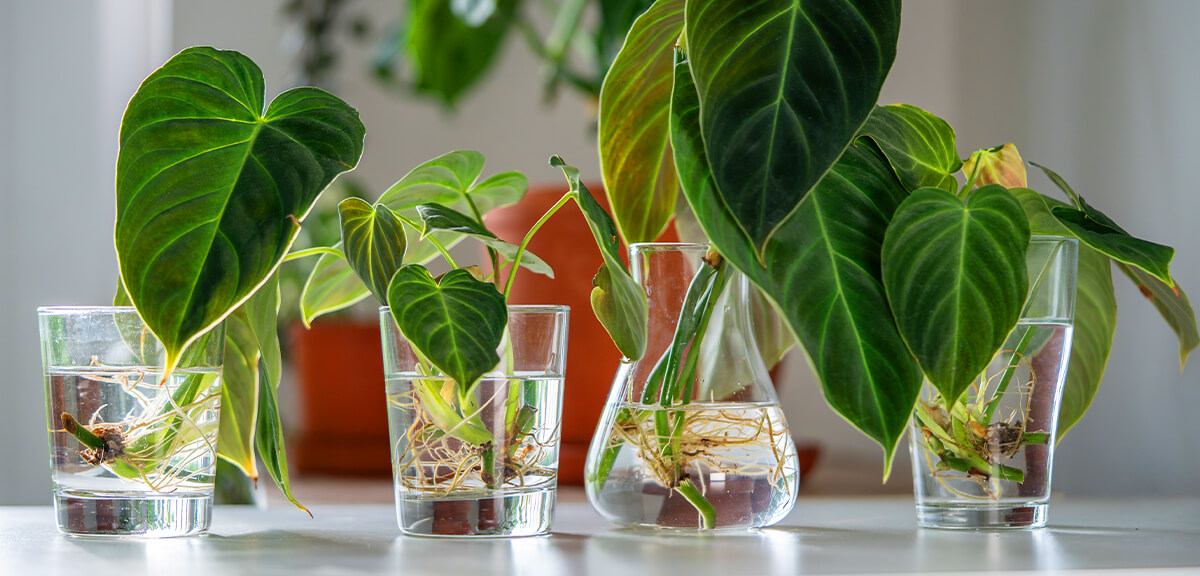
Propagate by stem cuttings
In this method, you use a stem from the mother plant to propagate the plant. Depending on the type of plant, you can propagate in a potting mix or in water. Some suitable plants for stem cuttings include begonia, pothos, philodendron, monstera, Chinese money plant, string of hearts, dieffenbachia, scindapsus and peperomia.
The method is simple. Trim off a stem of about 10-15 cm (4-6”), just above a leaf of the mother plant. Remove the lower leaves from the stem, dip the cutting in rooting hormone to about 3.5 cm (1.5”) and use a pencil to poke a hole in the potting mix, or you can let the cuttings root in water for a few weeks before transferring them to potting mix.
If you put the cutting directly in the potting mix, then keep the mix moist but not overly wet, and as an added option, cover with a plastic bag. If you want to propagate the cutting in water, then put it in a glass with enough water to cover the bottom few inches of the stem. Change and top up the water regularly and wait to repot when you see new roots in a few weeks. When the roots are 4-5 cm (2”), you can plant the rooted cutting in a pot with potting mix.
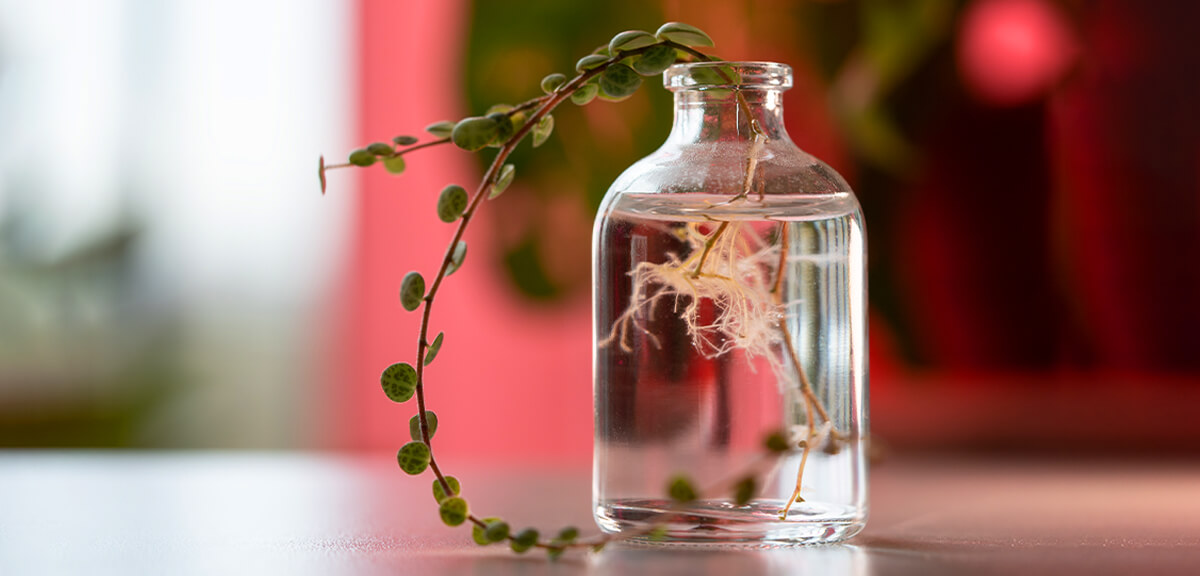
Propagate by head cuttings
For this type of cutting, you prune off the head or top of the mother plant and let it grow into a new plant. Some suitable plants for head cuttings are dracaena, ficus, yucca and schefflera.
Here’s how to do this:
- Use a sharp tool to cut off the head of the plant or a side stem. Make sure the cutting is about 15 cm (6”) long. Trim off the cutting just above a leaf of the mother plant.
- Cut off any leaves on the bottom half of the head cutting. Dip it in gel rooting hormone.
- Place the head cutting in lukewarm water and wait for new roots to form. This will take a few weeks.
- When the roots are about 5 cm (2”) long, it's time to plant in a pot full of good potting mix.
- When the new cutting is established, you can repot it into a larger pot.
Propagate by leaf cuttings
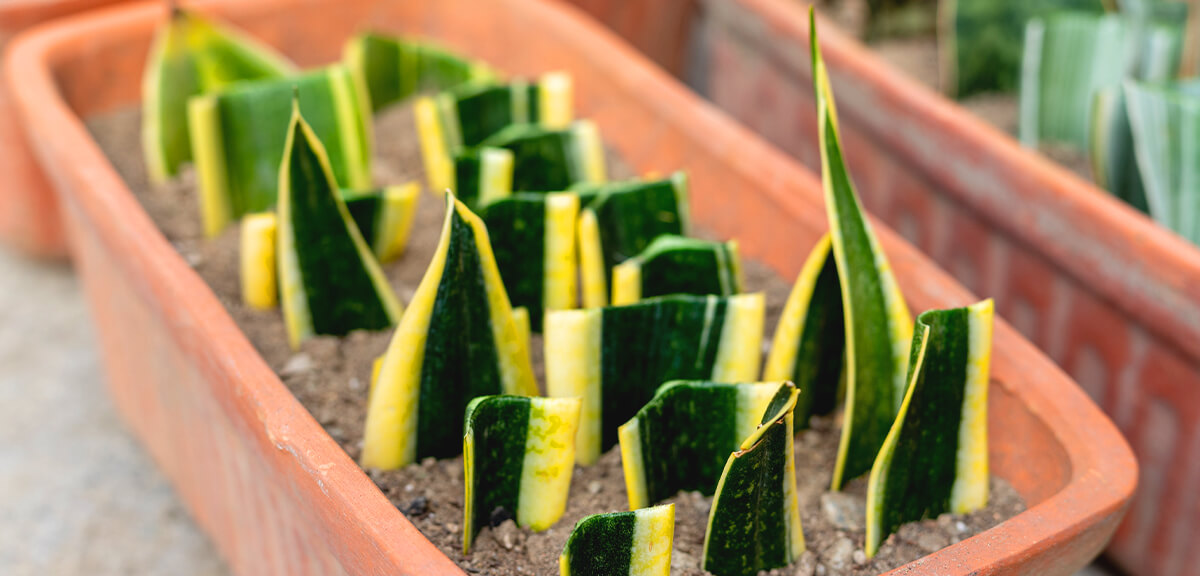
This involves using a leaf from the mother plant as a new cutting. Plants with firm leaves are suitable for leaf cuttings. The leaf you cut grows its own roots and you don't put them in water, but directly in a potting mix. The following plants are highly suitable for leaf cuttings: aloe vera, agave, snake plant, jade plant, prayer plant, kalanchoe, African violet, peperomia and rex begonia.
How to proceed:
- Take a sharp knife and cut off the leaf as close to the stem or stalk as possible.
- Remove any remaining stalk from the leaf, so that the leaf's vein is in direct contact with the potting mix later.
- Dip the leaf into some rooting hormone.
- Stick the leaf about 1 cm deep into the potting mix in a small pot.
After a while, roots will grow from the leaf veins. When the leaves have rooted, you can repot them to a larger pot with potting mix.
Tip: To prevent your cuttings from rotting, don't put them directly into a moist mix. The leaves can often do without water for a while. To increase the humidity around the plant, simply mist the cuttings regularly.
Propagate by partial cuttings (splitting)
Many houseplants can be divided (split) to create new plants, which also helps rejuvenate overgrown and crowded houseplants. This can be done by cutting or tearing the plant into two or more sections. This should be done carefully, however. The following plants are suitable for dividing: Chinese evergreen, zebra plant, prayer plant, snake plant, ZZ plant, peace lily, ferns and monstera.
This is the way to do it:
- Water your plant a day before you want to divide it to ensure that the mix is soft and makes it easier to pull roots apart without damaging them.
- Remove the plant from the pot.
- Clean the root ball thoroughly by removing as much potting mix from it as possible.
- Look for natural divisions within the root ball. With your hands (or with a knife if it's tough going), carefully tear apart into sections with foliage and roots.
- Place the plants into a pot with a good potting mix as soon as possible. Make sure the roots are well covered and that the plants stand firm.
- Give your new plants plenty of water.
- Keep the potting mix moist but not too wet, to prevent root rot.
Propagate houseplants by root/rhizome cuttings
With this method, you’ll be using pieces of root or rhizomes from the mother plant to grow new plants. You take one or two roots from a healthy plant to do it. Plants suitable for taking root cuttings include anthurium, alocasia, ferns, begonia, ZZ plant, snake plant and primula.
How to proceed:
- Remove the mother plant from the pot.
- Clean the root ball thoroughly by gently rubbing off the potting mix with your hands.
- Cut off one or two thick roots just below the top of the root ball.
- Cut the root(s) into several pieces. With this method of cutting, it doesn't matter how long the cuttings are as long as they fit into the pot.
- Dip them in rooting hormone before placing them in a seed tray or small pot with potting mix, making sure the root cuttings are completely covered.
- Place the mother plant back into its potting mix as soon as possible and top up the potting mix.
Expect to see leaves developing at the top of the cuttings after a month or so but wait a few more weeks before repotting, because roots will develop following the leaves. After a few weeks, new roots will grow above ground. Then it's time to repot the cuttings into a slightly larger pot with potting mix.
Propagate with offshoot cuttings
The easiest way of taking cuttings is using offshoots, often called “pups” or “plantlets”, as they're already growing next to (or on) the mother plant. The cutting often has its own roots and is already a small plant. The following plants are examples of houseplants suitable for offshoot cuttings: Chinese money plant, banana plant, aloe vera, echeveria, money tree, spider plant and snake plant.
If the offshoot is next to the mother plant, take the plant out of the pot and feel with your fingers where the plant might be attached. Carefully pull it loose with a sharp, clean knife, separating its roots from those of the mother plant.
If the pup has good roots already, place it into a pot with potting mix. If the pup does not have enough roots yet, then you may want to let it root in water first before potting it. Take a small container with lukewarm water, place the pup in it, and wait until the roots are around 5 cm long. Change the water once a week.
If the pup is at the end of a stem, like on a spider plant, then cut it off the mother plant and place it in water until it has sufficient roots to be planted in a potting mix.
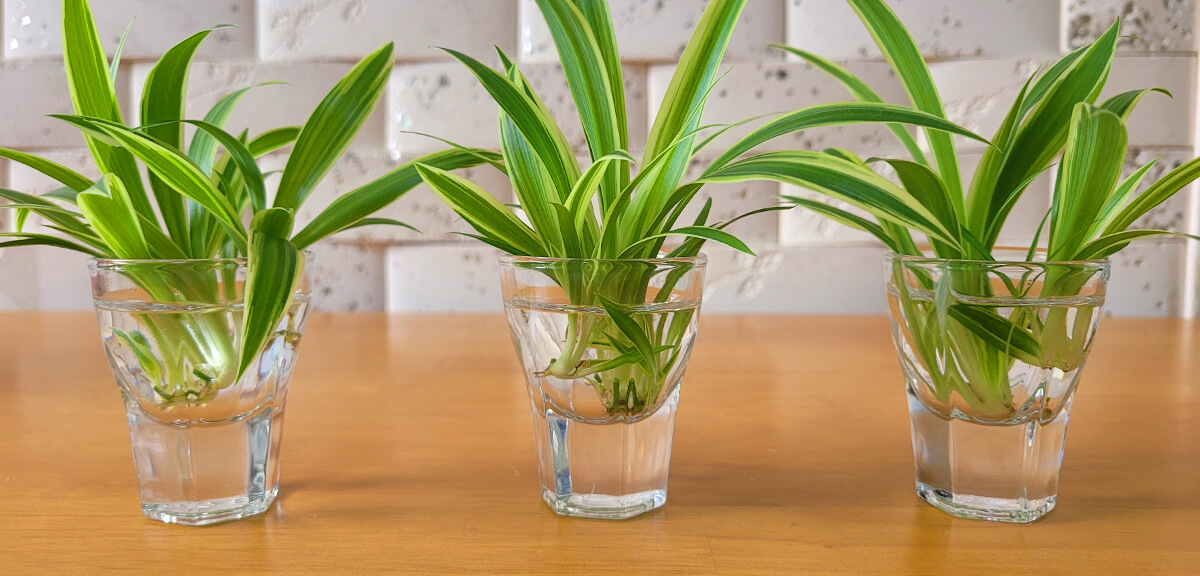
The best way to get free plants in no time!
Propagating houseplants is extremely easy and a great way to multiply plants for free using simple methods like water or soil propagation. Common plants like pothos, snake plants and succulents can be propagated by beginners using cuttings or division in just a few weeks.
